Q1 2026 Review · Becoming a Builder
This review has both Chinese and English versions; they differ slightly — each is written for its primary audience rather than as a direct translation.
TL;DR: If you're busy, here are the 3 main takeaways
- Introduction: "It is not that we have a short time to live, but that we waste a lot of it," as Seneca observed two thousand years ago. To capture memories before they fade, I'm building a habit of writing quarterly reviews. This is the very first one I'm sharing with you.
- A New York job opening in early 2026 sparked my biggest growth and shift this quarter: embracing a new identity as a "Builder". This new identity also kicked off a 12-year Pay-it-Forward project (PIF12), and you're invited to join.
- Things I discovered or built in Q1 that I want to share with you:
- Crypto insights: Blockchain pioneer Ping Chen's 10-year review on Ethereum (asking if crypto still makes sense in 2026); and Stacy Muur's Web3 GTM playbook based on a16z data.
- Builder's path: I bookmarked The Modern Software Developer (CS146S) — haven't started yet, but I believe it'll substantially upgrade my building skillset. Also Dan Koe's How to fix your entire life in 1 day — I don't think anyone actually fixes a messy life in a day, but his framework offers genuine insights, especially "Turn Your Life Into A Video Game."
- Reads: The Book of Elon; Jessica Hagy's How to Be Interesting (In 10 Simple Steps) — a book full of Venn diagrams and distilled wisdom, with practical tips for living an interesting life. Preview of next quarter: Tyler Cowen's Marginal Revolution generative book — read with his AI co-pilot.
- AI Translation: I found Paul Graham's The Brand Age fascinating, so I collaborated with my AI to translate it into Chinese for my local audience.
- Law x AI: You absolutely cannot miss Zack Shapiro's vision of a Claude-Native Law firm and the subsequent discussion.
- Voices in my head this quarter: Naval Ravikant on patience (the 10-year career view); Charlie Munger on getting rich ("so you don't have to get along with other people"); and Steve Jobs on agency. Full quotes unfold later in this review.
- Facing my habits: Instead of hating myself for phone addiction, I decided to extract value from my lost time. I used AI to analyze my watch history of over 2,000 YouTube & Instagram videos in Q1. The gems I highly recommend: lawyer and communication expert Jefferson Fisher on The 3 Rules for Strong Adult Friendships; Tony's "My Son Says I'm an Idiot" series (Chinese narration with English subtitles — the family humor is universal); Sheldon Cooper's "The best number is 73" from The Big Bang Theory — math nerd humor that delights every time; Kevin Spacey's address at the Oxford Union, a reminder of the limits of law and the bottomlessness of social witch hunts; and finally, YC's Garry Tan on How to engineer your own good luck.
- Let's connect: I'm hosting "Run & Dine" meetups, looking for language exchange partners, or you can simply chat with my AI assistant Lia, drop me your email, or check out why I started live-streaming my diary (Mandarin).
The Main Quest: Becoming a Builder from an opportunity in NYC
I have been following Variant Fund, a New York-based VC specializing in early-stage crypto, by reading its insightful pieces on legal practice and policy. Early this year, I saw an opening for a Deputy General Counsel.
The requirements were highly unusual:
- Only 2 years of legal experience required.
- Crypto experience needed.
- Big Law experience not required.
To me, this felt like a role tailor-made for me.
I haven't looked at US-based jobs in a while — after moving back to Taiwan, there were return-of-service obligations from my scholarship plus the usual visa headaches. But this opening made me flip my thinking: Assuming I had US work authorization, how would I prove I'm the right fit?
This thought experiment broke my self-imposed limits and sparked an (illusory yet powerful) sense of hope.
Initially, I thought about making a slide deck. But knowing my friends in consulting or even Gen Z interns could design a much prettier presentation, I decided to leverage a new skill: vibe coding a website instead.
Using "vibe coding" (writing code via natural language prompts), I built a one-page pitch website addressing their requirements point by point. I even consulted a NY immigration lawyer regarding visa feasibility.
Through this research, I was drawn to Variant Fund's philosophy. It wasn't just their focus on seed-stage crypto, but their belief that "Policy Is the New Edge." In their culture, the legal team isn't a cost center or a mere risk-management checklist; it's an active value creator and policy shaper, engaging in rule-making and dialogue.
This sparked an interesting internal conflict. I admire their "Ownership Economy" ideals, yet watching the evolution of the crypto space, I also see what Nobel laureate George Stigler described in 1971 as "Regulatory Capture" 1. It left me with mixed feelings.
But on a personal level, the underlying idea — legal is a plus, not a box — resonated deeply. My legal background should be a plus, one of many tools in my problem-solving toolbox, not a career armor that keeps me in a narrow, predictable professional path.
The Dual Meaning of a Builder
Starting from that pitch website, my vibe-coding journey as a Builder took off.
I migrated my personal website from Google Sites to GitHub Pages and started blogging using Git and Python. Inspired and encouraged by my mentor Alex Liu, I built an AI Chatbot. After multiple iterations, Lia is finally ready for the world to chat with.
I also built a custom Telegram bot to act as my personal assistant and attention coach. (It still hallucinates and lies constantly, but hopefully, it will stabilize by the end of Q2 so I can open-source it).
Brick by brick, building my own tools shifted my self-identity toward being a "Builder." Usually, this term implies a developer. I don't want to flatter myself since I can barely write raw code, so perhaps "creator" or "maker" fits too.
Then it hit me one day: my Chinese name, 建順, literally translates to "Build (建) Smoothly (順)." Call it a forced connection, but I'm claiming it.
Being a Builder means two things to me: practicing how to use various tools to solve problems, and realizing that the process of building is the answer itself.
People say startups should create value by solving societal problems, but maybe I need to solve my own first: forgetfulness, tech-induced loneliness, phone addiction, and swinging between hope and despair about the future. To solve these, I need to know myself better, and I can only do that by interacting with the world and trying new things. Redesigning my website, live-streaming my diary, writing quarterly reviews, and building Lia — these are all experiments and actions. Actions that shape and reinforce my builder identity.
On the surface, it's a craftsman's mindset: I want to make things with my own hands to prove I exist.
Deeper down, it's an answer to a lingering question: Since entering Web3 in 2018, I've wrestled with one core doubt — Is crypto actually useful?
Last year, I tried to answer this academically with a paper titled "Ponzi or Promise." The title itself was a soul-searching question. After multiple boom-and-bust cycles, billions invested, and massive energy consumed, is it just a casino, or is it a genuine promise for future financial inclusion? I wrote 10,000 words and gave a 25-minute presentation, but still had no answer.
Now, I want to answer it differently — by building.
If a technology is truly useful, beyond capitalistic market speculation, it must deliver concrete value that a human community cares about — things like digital identity, blessings that span time, non-transferable testimonies, and voluntary community structures.
This brings me to PIF12.
PIF12: An Organically Grown 12-Year Project
During a family trip over the Lunar New Year, I impulsively started a 30-day "AI × N" sprint, writing daily insights about AI 2.
From this sprint, a project grew organically: Pay It Forward 12 (PIF12).
Why Do This?
I have been incredibly lucky to meet so many helpful mentors and fascinating souls in my life. But many of them disappeared after helping me, expecting nothing in return. More importantly, after two years of remote work, I felt like I was disappearing from my own social circles.
I want to gather these people: to bring together those still in my life, and to pay forward the blessings of those who have passed through it.
(The term 佩福 is also a wordplay that echoes a Confucian saying, 永言配命,自求多福 — "align yourself with destiny, seek your own blessings and luck.")
A Form Born from Lunar New Year
Every Lunar New Year, I send greetings to family and mentors. I realized that competing for attention via text messages during the holidays is fundamentally irrational — like everyone standing up at a concert, making it harder for everyone to see.
So I had a thought: Since I want to prove blockchain is useful for more than just speculation, why not turn my annual blessings into NFTs?
I recalled Vitalik Buterin's concept of Soulbound Tokens (SBTs) 3 — essentially, non-transferable NFTs. Without transferability, there is no liquidity and no speculation, bringing it back to the core of community: human relationships.
So PIF12 will look like this: Every year, I will mint an SBT documenting my growth and send it to people I admire, like-minded peers (both new and longtime), and helpful friends. Together, we will form an organic community as an antidote to tech isolation and indifference.
The 12-Year Vision
By the 12th year, I hope this evolves into a sustainable, self-organizing community for lifelong learners, people who love the intersection of tech and humanities, and those exploring "how humans collaborate."
I am committing to minting one SBT per year based on the Zodiac and hosting one physical meetup annually. Beyond that, I'll let the community grow organically.
(Fun fact: The Vietnamese Zodiac has a "Year of the Cat." Who wouldn't want to stick around to collect a Cat SBT?)
→ Check out the PIF12 Project Page
Internal Conflict: Naval vs. Elon
This quarter, I had two voices fighting in my head.
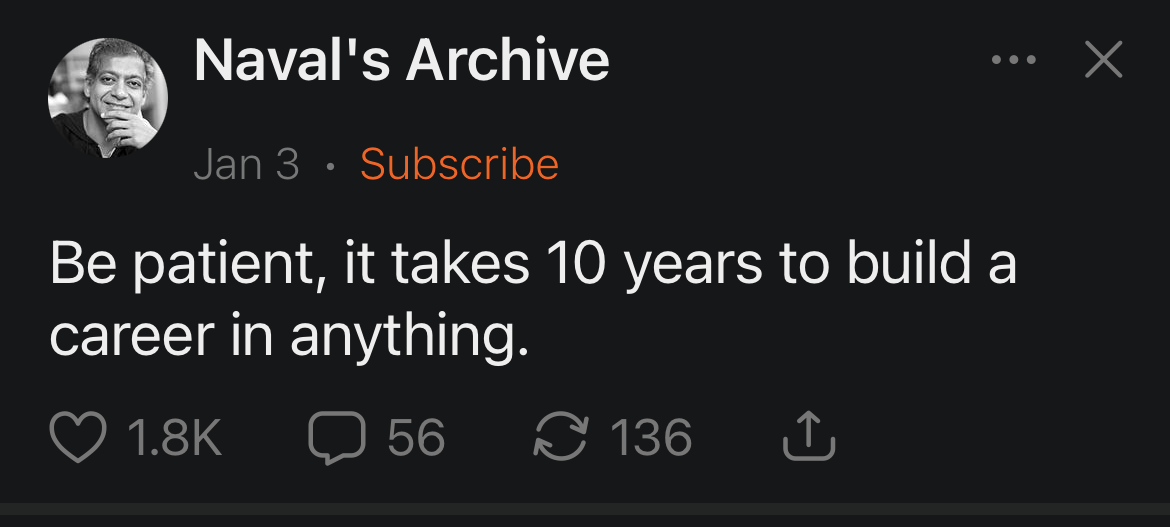
Naval Ravikant: "Be patient. It takes 10 years to build a career in anything."
Elon Musk: "Stop being patient and start asking yourself: How can I accomplish my 10-year plan in 6 months? You will probably fail, but you'll be far ahead of the person who simply accepted it would take 10 years."
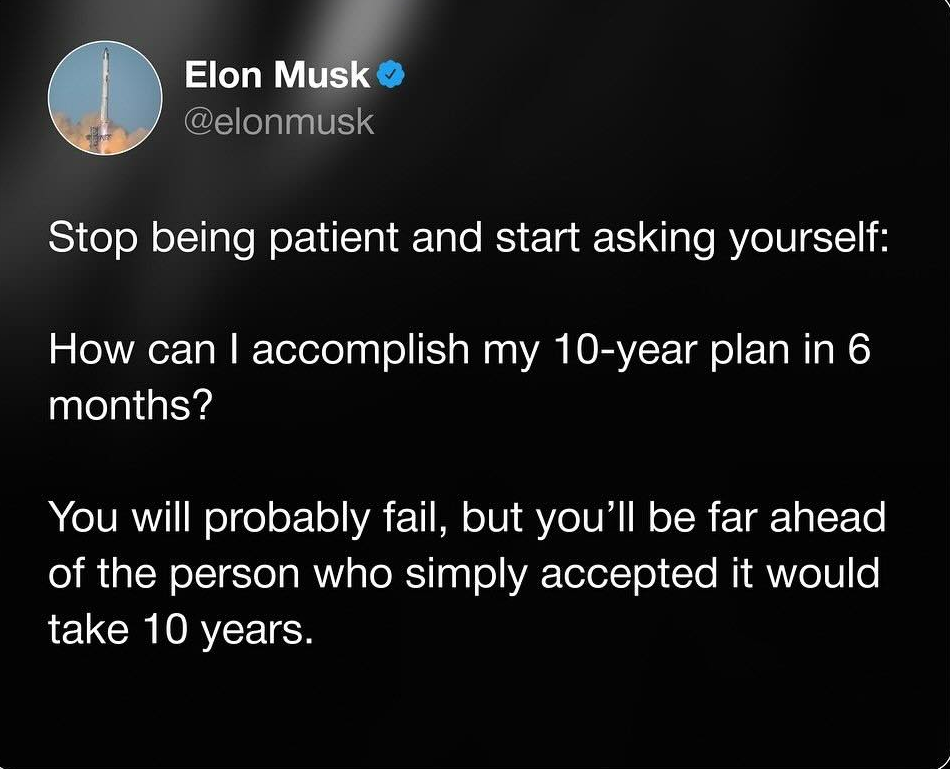
Living between these two voices — sometimes I feel there's no rush; other times I feel I'm running out of time and work like my life depends on it.
My realization this quarter is that they aren't mutually exclusive. We need a long-term vision of an ideal future, but we must fiercely focus on the immediate tasks, leverage the tools at our disposal to the absolute maximum, and actively solve problems now.
"Agency" has become a buzzword since last year. My understanding of it is: acting boldly without needing permission to shape the world the way you want it. As Steve Jobs said, once you realize you can poke life and change it, you'll never be the same again.
In 2019, a Taiwanese company quoted me US$10,000 and a month of work for the kind of website I built this Q1. Now, for US$20 a month and a week of talking to my computer, I built it myself. I'm not saying my development skills are as good as professional engineers', but AI is rapidly dismantling technical barriers and leveling the playing field.
Of course, to change the world, you also need luck. Psychologist Richard Wiseman's research on luck shows that people who consider themselves lucky simply notice opportunities more often. If you firmly believe you are chronically or inherently unlucky, you'll spend your life proving yourself right, probably becoming a self-fulfilling prophecy.
Agency means asking for what you want, writing the email, making the call. Make yourself worthy of the luck that comes your way, resonating with the Confucian saying 永言配命,自求多福 ("align yourself with destiny, seek your own blessings and luck.")
The Evolution of Human Collaboration: AI meets Crypto
Between Q1 and Q2, I had an epiphany:
AI and Blockchain are not just technological shifts; they are fundamentally changing how humans collaborate.
Crypto's original flag was "decentralization" — removing middlemen, trusting cryptography, and using DAOs to forge new collaboration paradigms.
And AI? I used to think it was just a productivity booster. But I'm realizing it's a phase shift. The Singularity is nearing, and people might increasingly prefer collaborating with AI over other humans. (See Jack Dorsey's insights on moving From Hierarchy to Intelligence).
Charlie Munger once said, "The point of getting rich is so you don't have to get along with other people." With AI fulfilling our daily needs, a future where we rarely interact with humans isn't just a dystopian fantasy; it's becoming highly feasible.
An old Chinese saying — "a single day's needs depended on a hundred trades" (一日之所需,百工斯為備) — is becoming obsolete; AI is collapsing those trades into a single prompt. The Taoist ideal of "living and dying without contact with one's neighbors" (老死不相往來) is no longer a hermit's fantasy but a tangible default.
I refuse to accept a future where human-machine collaboration entirely replaces human-to-human interaction.
That's why I write this quarterly review — to be transparent, easily understood, and to send out a tiny signal: I am a human, looking to collaborate with like-minded humans. PIF12 is my testing ground for this.
(Though, the irony would be if I only end up attracting time-traveling Terminators to collaborate with.)
ETHTaipei Meetup & TCE
Another highlight was speaking at an ETHTaipei meetup in March. I distilled my dense academic paper into a practical talk: "Web3 Legal Thinking 3-2-1 for Product & Community Design." It forced me to deliver actionable insights as a Builder rather than just armchair theorizing. Read the recap here.
I want to thank a few people who made this stretch possible. XREX gave me, fresh out of law school, a seat at the table for blockchain legal practice across APAC. The cohort I co-organized a Web3 legal reading group with in 2024 kept the dialogue going. And Prof. Yueh-Ping (Alex) Yang with the Taiwan Blockchain Academia ran the 2025 reading group on Taiwan's emerging crypto regulations and global developments. These experiences let me finish last year's Q4 paper for the National Conference on Technology Law and shape this small meetup talk.
Honestly, in the modern explosion of information and ever-changing technology, this dense web of theory and practice is — to borrow Zhuangzi — a finite life chasing infinite knowledge: doomed to fail, meaningless. Yet that very meaninglessness is what lets us build our own meaning, and break free from nihilism.
I also joined the Taipei Club of English (TCE), a self-governing, community-run club that survived the pandemic. Everyone is a member, and everyone takes a turn hosting events. Counterintuitively, that shared obligation is exactly what makes it work — no egos, just people learning, watching sports, and hiking together.
My loudest 20 seconds of Q1 (WBC)
When I envision what PIF12 should feel like in a decade, TCE is exactly what comes to mind.
Small Mindset Shifts
Growing My Hair
I haven't cut my hair in three months. I used to think long hair didn't suit me. I don't know if I'm just learning to accept myself, but I'm enjoying the experiment.
Rewatching Dragon Ball
I watched Frieren, Jujutsu Kaisen, Everything Everywhere All at Once, Godzilla Minus One, and rewatched the Dragon Ball Z series. I used to reject Dragon Ball Super because it "wasn't the Dragon Ball from my childhood." But rewatching it with my girlfriend, I realized aging has actually made my mind more open.
Random Train to Ruifang
Feeling down one sunny day, I grabbed my transit card and hopped on a random train. It ended in Ruifang, leading to an impromptu day trip to the North Coast in Taiwan. No grand epiphanies, but the randomness itself was special.
Debts & Q2 Plans: Things Yet to be Done
1. Fuji Marathon Review + "Run & Dine"
I ran the Mt. Fuji Marathon late last year — a "successful failure" finish. I could barely walk in January 2026. While I couldn't finish writing my Fuji Marathon review as I originally planned, I want to release a video review in early May.
Also, after recovering from my leg problems post-marathon, I participated in a local "Run 10K for a Free Meal" campaign by Second Floor Cafe. I got three meals for free in Q1 2026. I loved it so much that I'm funding my own version: I'm inviting running buddies in metropolitan Taipei. If you can run 8K at an 8:00/km pace, let's grab a meal afterward (1 person/week until Sept 30, 2026).
→ Want to run and eat? Email me at hello@jasonjlai.net with the subject "Run & Dine."
2. Getting PIF12 On-Chain
I've been procrastinating on actually moving forward with this project. Currently, I am considering tying it to an Emergent Ventures grant application to force myself to clarify the project details. Expect updates next quarter!
3. Less Watching, More Making
The recent lawsuit against Google and Meta reminded me that social media addiction is real, and in Q1, I experienced it firsthand by watching over 2,000 videos on YouTube and Instagram. But instead of just complaining about digital intoxication or doing a passive "digital detox," I decided to take back control and pivot that attention toward creation. Therefore, I deleted the apps from my phone and committed to a hard deadline to maintain my rhythm. Coming in May: a new video on "Bayesian Thinking" (Part 1 of my Systems Thinking trilogy).
Closing Thoughts: Seeing is Enough
This quarter, I was pulled in different directions:
Preparing for a 10-year game like Naval, while trying to rush it into 6 months like Elon.
Committing to a 12-year PIF project, while blushing that it's not even on-chain yet.
Questioning crypto academically, while answering it as a Builder.
I don't have all the answers, but perhaps just seeing and being seen is a good enough starting point.
📮 Want to stay in touch? Leave your email
It's been a while since I wrote a long-form update. I'd love to hear how old and new friends are doing.
I collect emails to share my life — a bilingual quarterly review like this one, and occasional essays. This is not a sales funnel. However, because it's a personal update, I will mention events I host, side projects, or even commercial endeavors. If that bothers you, feel free to skip it.
If you don't want emails but want to see my daily life, I've started live-streaming my diary on YouTube. Come and go as you please.
Drop your email here | Why I live-stream my diary (Mandarin)
Finally, let's end with a song
🎵 Edith Piaf — Non, Je ne regrette rien (1960)
Je repars à zéro. I start from zero.
Aujourd'hui, ça commence avec toi. Today, it begins with you.
Happy Building!
Jason Lai
2026.5.3
-
George Stigler's The Theory of Economic Regulation (1971) points out that regulations intended to protect the public are often acquired by industries and designed for their benefit. In February, I wrote an unpublished observation on Circle proposing the regulation of "synthetic dollars." Next time you see a consumer protection bill, ask not what it claims to do, but who profits from it. ↩
-
Just daily jottings, but if you're interested: 30 Days AI × N Posts ↩
Last updated: 2026-05-03
Stay Connected 中英雙語
Drop your email for bilingual (EN/中) personal thoughts & collab invites first. No Spam and cancel anytime.
訂閱搶先看中英雙語個人動態與活動。保證無垃圾信,隨時取消!